The Case for Rethinking Your Browser
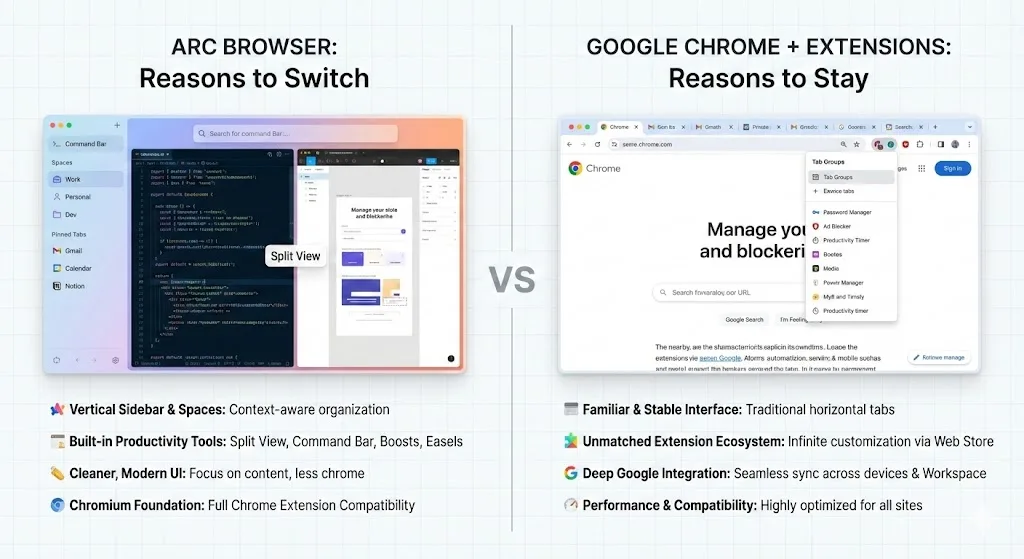
Arc Browser, built by The Browser Company, arrived with a bold promise: a browser redesigned from scratch for how people actually work today. Instead of the traditional tab bar across the top, Arc uses a sidebar with Spaces, pinned tabs, automatic tab archiving, and a fundamentally different approach to organizing your browsing.
For people frustrated with Chrome's tab management, Arc is appealing. But switching browsers is a significant commitment that affects everything from saved passwords to extension compatibility. The question is not just whether Arc is better at tabs -- it is whether the improvement justifies the migration cost.
What Arc Gets Right About Tab Management
Arc introduced several tab management concepts that Chrome does not have natively:
Spaces
Arc's Spaces are like workspaces within a single browser window. Each Space can have its own set of pinned tabs, color theme, and browsing context. Switching between Spaces swaps your entire tab environment. This is built into the browser itself, not bolted on through an extension.
Automatic Tab Archiving
Arc automatically archives tabs you have not used for a set period (12 hours by default). Archived tabs move out of your sidebar into a searchable archive. This prevents tab buildup without requiring manual cleanup.
Sidebar Navigation
Arc moves tabs from a horizontal bar at the top to a vertical sidebar on the left. This gives you more space for tab titles (since titles are displayed vertically rather than squeezed into tiny horizontal tabs) and keeps your most important tabs pinned and visible.
Split View
Arc lets you split your browser window to show two pages side by side without needing a separate window. This is useful for referencing documentation while working, or comparing two pages.
What Chrome Gets Right
Chrome's advantages are not about flashy features -- they are about ecosystem and reliability:
Extension Ecosystem
Chrome has the largest extension library of any browser. Whatever workflow you need, there is likely an extension for it. Arc supports Chrome extensions (it is Chromium-based), but some extensions do not work perfectly in Arc's modified interface, and Arc's extension management is less mature.
Enterprise and IT Support
Chrome is the standard in most workplaces. IT departments manage Chrome policies, deploy Chrome updates, and build internal tools for Chrome. Using Arc in a managed enterprise environment can create friction or may not be permitted at all.
Website Compatibility
Chrome is the browser most web developers test against. While Arc uses the same Chromium engine, its modified interface occasionally causes layout issues on sites that expect standard Chrome behavior.
Stability and Track Record
Chrome has been the dominant browser for over a decade. Its bugs are well-documented and quickly fixed. Arc, while promising, is newer and still evolving. The Browser Company has also shifted focus toward other products, which raises questions about Arc's long-term development trajectory.
Feature Comparison
| Feature | Chrome (+ Extensions) | Arc Browser |
|---|---|---|
| Tab Groups | Native (names, colors) | Spaces (similar concept) |
| Tab Backup/Restore | Via extensions (e.g., TabGroup Vault) | Limited (Spaces persist) |
| Auto-Archive Tabs | No (needs extension) | Built-in |
| Sidebar Tabs | No (needs extension) | Built-in |
| Split View | No (use separate windows) | Built-in |
| Extension Support | Full Chrome Web Store | Most Chrome extensions (some issues) |
| Profiles | Full multi-profile support | Built-in Profiles within Spaces |
| Cloud Sync | Google Account sync | Arc Account sync |
| Enterprise Support | Extensive (IT policies, MDM) | Limited |
| Platform Availability | Windows, Mac, Linux, iOS, Android | Mac, Windows, iOS |
| Memory Management | Built-in Memory Saver | Auto-archive reduces memory |
| Price | Free | Free |
Can Chrome + Extensions Match Arc's Tab Management?
This is the practical question. Can you get Arc-like organization without leaving Chrome?
The short answer: mostly yes, though with some trade-offs. Here is how to replicate Arc's key tab management features in Chrome:
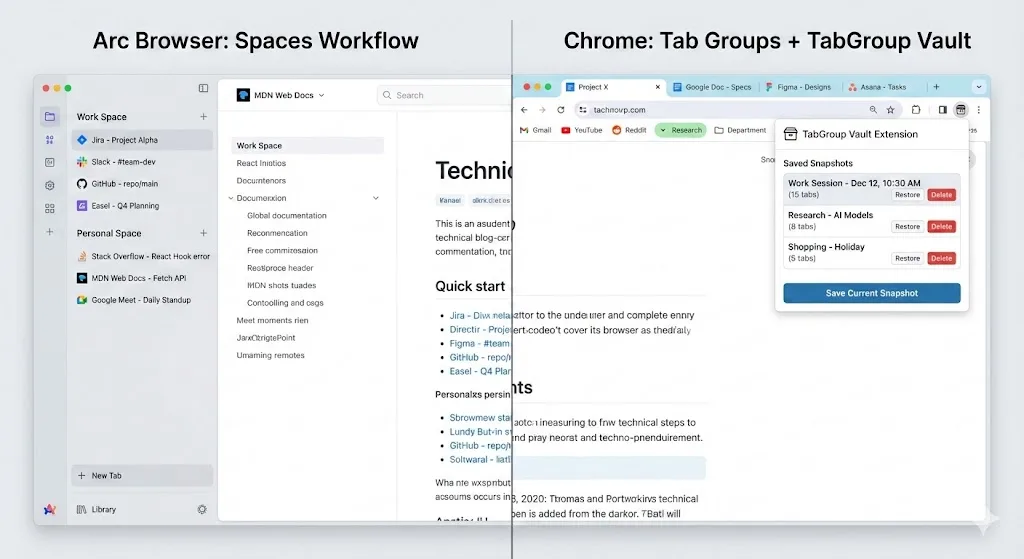
Arc Spaces = Chrome Tab Groups + TabGroup Vault
Chrome's native tab groups give you named, color-coded collections of tabs -- conceptually similar to Arc's Spaces. The missing piece is persistence: Chrome tab groups can vanish after crashes or updates.
TabGroup Vault fills this gap. It saves your tab group layout as a snapshot and restores it on demand. Your groups survive crashes, updates, and restarts. This gives you Arc-like workspace persistence within Chrome.
Arc Auto-Archive = Chrome Memory Saver + Manual Habits
Chrome's Memory Saver automatically suspends inactive tabs, which partially addresses tab buildup. For true auto-archiving (removing tabs from view entirely), you would need to build a habit of periodically saving snapshots with TabGroup Vault and closing finished groups. It is not as automatic as Arc, but it is effective with discipline.
Arc Sidebar = Tab Group Collapse
Chrome's tab groups can be collapsed, which hides all tabs in a group behind a single label. This achieves a similar effect to Arc's sidebar -- your active tabs are visible while inactive groups are collapsed to labels. It is not a sidebar, but the organizational benefit is comparable.
Arc Split View = Separate Windows
Chrome does not have built-in split view. The workaround is using two browser windows side by side, which your operating system can facilitate with window snapping features. It works, but it is less elegant than Arc's integrated solution.
The Chrome Enhancement Stack
To get the closest experience to Arc's tab management in Chrome:
1. Use Chrome tab groups for workspace organization
2. Install TabGroup Vault for group backup and restore ($29 lifetime)
3. Enable Memory Saver for automatic tab suspension
4. Collapse inactive groups to keep the tab bar clean
This setup provides workspace organization, persistence, and memory management without switching browsers.
The Switching Cost
Switching browsers is not a casual decision. Here is what migrating from Chrome to Arc actually involves:
- Passwords and autofill: You need to migrate or re-enter your saved passwords and payment methods.
- Extensions: Most Chrome extensions work in Arc, but some may not function correctly in Arc's modified interface. You need to test each one.
- Muscle memory: Arc's keyboard shortcuts, navigation patterns, and interface layout are all different. Expect a learning curve of days to weeks.
- Synced data: Chrome sync ties together bookmarks, history, open tabs, and settings across devices. Arc has its own sync, but migrating that data is not seamless.
- Work restrictions: If your workplace manages Chrome via IT policies, switching to Arc may not be an option.
These costs are real. For some users, Arc's tab management improvements justify the switch. For many others, enhancing Chrome with extensions is the more practical path.
TabGroup Vault: Arc-Like Persistence for Chrome
What it does: Saves and restores Chrome tab groups with full structure (names, colors, tabs)
Price: Free (5 snapshots) / $29 one-time lifetime Pro
Backup: Google Drive integration for cross-device safety
Result: Your Chrome tab groups persist like Arc's Spaces, without switching browsers
Arc's Future: A Note of Caution
The Browser Company has publicly shifted its focus toward new products beyond Arc. While Arc continues to function and receive maintenance updates, the pace of new feature development has slowed. For users considering a major browser switch, the long-term commitment of Arc's development team is a factor worth considering.
Chrome, backed by Google's resources, is not going anywhere. Extensions like TabGroup Vault continue to evolve alongside Chrome's own feature updates. The Chrome ecosystem's stability is a quiet but important advantage.
Who Should Switch to Arc
- You are frustrated with Chrome's interface and want a fundamentally different browsing experience
- You do not rely on Chrome-specific enterprise tools or IT policies
- You are on Mac or Windows and do not need Linux support
- You enjoy adopting new tools and do not mind a learning curve
- You want built-in split view and sidebar navigation without extensions
Who Should Stay with Chrome
- You rely on specific Chrome extensions that may not work perfectly in Arc
- Your workplace manages Chrome via IT policies
- You need cross-platform support including Linux, Android, or ChromeOS
- You prefer to enhance your existing setup rather than start over
- You want the stability of the most widely used and tested browser
The Bottom Line
Arc is a genuinely innovative browser that rethinks tab management in ways Chrome has not matched natively. If you are willing to invest the time in switching and Arc's design resonates with how you think about browsing, it is worth trying.
But for users who are already invested in Chrome's ecosystem, the combination of Chrome tab groups, TabGroup Vault, and Memory Saver provides workspace organization, persistence, and performance management that covers most of Arc's tab management advantages -- without the cost of switching browsers.
The best browser is the one that fits your workflow with the least friction. For many people, that means enhancing Chrome rather than replacing it.